This article traces Origen Adamantius’ extraordinary life and formative influence upon early Christianity. I ask how the Church could later condemn such a master, whose thought had already shaped generations of her greatest Fathers.
The Man of Steel
That Origen, called Adamantius—”the man of steel,”—was born in 185 A.D. and grew up in a Christian family in Alexandria. Under the education of his father, the martyr Saint Leonides, Origen was trained in scripture even before he was given a proper secular education.
The Church historian and Origenist Eusebius of Caesarea writes:
“Nor was this irksome to the boy, but he was eager and diligent in these studies. And he was not satisfied with learning what was simple and obvious in the sacred words, but sought for something more, and even at that age busied himself with deeper speculations. So that he puzzled his father with inquiries for the true meaning of the inspired Scriptures. And his father rebuked him seemingly to his face, telling him not to search beyond his age, or further than the manifest meaning. But by himself he rejoiced greatly and thanked God, the author of all good, that he had deemed him worthy to be the father of such a child. And they say that often, standing by the boy when asleep, he uncovered his breast as if the Divine Spirit were enshrined within it, and kissed it reverently; considering himself blessed in his goodly offspring. These and other things like them are related of Origen when a boy.”
Church History, VI.2.9–11 — Eusebius of Caesarea (d. 339).
We see that even as a young boy Origen was attributed with fabulous miracles.
When Origen was not quite seventeen, his father was arrested and martyred during the persecution under Roman emperor Septimus Serverus. Origen wished to join his own father in martyrdom, and was prevented only when his mother hid his cloths. Unable to leave the house, he wrote to his imprisoned father, exhorting him;
“Take heed not to change your mind on our account.”
Church History, VI.2.6 — Eusebius of Caesarea (d. 339).
His father’s property was then confiscated, leaving Origen, his widowed mother, and six younger brothers in poverty.
Origen the Teacher
Thereafter, Origen and his family would become destitute, forcing him to lecture and teach for money. Since most learned Christians were driven away in the persecution, the job of principal teacher would land on the teenaged Origen, as he became the dean of the Catechetical school in Alexandria, appointed by the bishop Demetrius.
He taught both Christians and Pagans, but held in special regard the martyrs, whom he would go out of his way to greet with a kiss on their way to death, infuriating the unbelievers. Several of his own pupils—Plutarch, Serenus, Heraclides, Hero, another Serenus, and Herais among them—would themselves suffer martyrdom.
As an apologist, he put much effort into refuting the doctrines of the Pagans in his works, for Christians had now to deal with an external intellectual threat at the hands of pagan philosophers. One such philosopher was Celsus, against whom Origen authored an entire treatise which remains extant, Contra Celsum.
For these reasons, the great teacher had to be constantly moved from house to house, in order to escape the persecution of those who wished to kill him, but he was also dearly loved for his virtue and right teaching.
Eusebius explains:
“For they say that his [Origen‘s] manner of life was as his doctrine, and his doctrine as his life. Therefore, by the divine Power working with him, he aroused a great many to his own zeal.”
Church History, VI.3.7 — Eusebius of Caesarea (d. 339).
Origen the Ascetic
Origen believed that a teacher of divine things should embody what he taught, and so he took up a life of asceticism. He sold his valuable books, lived on four obols a day (~$7 in today’s money), fasted, and restricted his sleep, among other things listed by Eusebius:
“He restrained himself as much as possible by a most philosophic life; sometimes by the discipline of fasting, again by limited time for sleep. And in his zeal he never lay upon a bed, but upon the ground. Most of all, he thought that the words of the Saviour in the Gospel should be observed, in which he exhorts not to have two coats nor to use shoes nor to occupy oneself with cares for the future. With a zeal beyond his age he continued in cold and nakedness; and, going to the very extreme of poverty, he greatly astonished those about him. And indeed he grieved many of his friends who desired to share their possessions with him, on account of the wearisome toil which they saw him enduring in the teaching of divine things. But he did not relax his perseverance. He is said to have walked for a number of years never wearing a shoe, and, for a great many years, to have abstained from the use of wine, and of all other things beyond his necessary food; so that he was in danger of breaking down and destroying his constitution.”
Church History, VI.3.9–12 — Eusebius of Caesarea (d. 339).
And the fruits of this ascetic life became manifest:
“By giving such evidences of a philosophic life to those who saw him, he aroused many of his pupils to similar zeal; so that prominent men even of the unbelieving heathen and men that followed learning and philosophy were led to his instruction. Some of them having received from him into the depth of their souls faith in the Divine Word, became prominent in the persecution then prevailing; and some of them were seized and suffered martyrdom.”
Church History, VI.3.13 — Eusebius of Caesarea (d. 339).
We see that he was far more than an academic.
His Theology
Before proceeding, we must resist the temptation to read Niceneo-Constantinopolitan theology (which developed in the early to late 4th century) back into the Christian world of Origen, who died around the mid 3rd century.
It should be understood that subordinationist Logos theology was widespread during this time. By subordinationist I mean that the Father is the supreme unbegotton God, while the Son is the pre-existent divine Logos, deriving His being, divinity, authority and operation from that source. This was not yet Arianism, but many today might argue that Arius‘ doctrines were drawn from those of Origen. The primary difference being that Origen affirmed the eternal generation of the Son, while Arius considered him to be created temporally.
For one instance outside of Origen, St. Justin Martyr calls the Logos:
“the power next to the first God.”
First Apology, 60 — Justin Martyr (d. c. 165).
Tertullian, though of a totally different methodological persuasion to Origen, writes:
“For the Father is the entire substance, but the Son is a derivation and portion of the whole, as He Himself acknowledges: ‘My Father is greater than I.’”
Against Praxeas, 9 — Tertullian (d. after 220).
Origen‘s own subordinationist view I find remarkably cogent, and indeed beautiful:
“To such persons [as Celsus] we have to say that God on the one hand is Very God (Autotheos, God of Himself); and so the Saviour says in His prayer to the Father, ‘That they may know You the only true God;’ (John 17:3) but that all beyond the Very God is made God by participation in His divinity, and is not to be called simply God (with the article), but rather God (without article). And thus the first-born of all creation, who is the first to be with God, and to attract to Himself divinity, is a being of more exalted rank than the other gods beside Him, of whom God is the God, as it is written, ‘The God of gods, the Lord, has spoken and called the earth.’ (Psalm 50:1) It was by the offices of the first-born that they became gods, for He drew from God in generous measure that they should be made gods, and He communicated it [divinity] to them according to His own bounty. The true God, then, is ‘The God,’ and those who are formed after Him are gods, images, as it were, of Him the prototype. But the archetypal image, again, of all these images is the Word of God, who was in the beginning, and who by being with God is at all times God, not possessing that of Himself, but by His being with the Father, and not continuing to be God, if we should think of this, except by remaining always in uninterrupted contemplation of the depths of the Father.”
Commentary on the Gospel of John, II.2 — Origen (d. c. 253–254).
To Origen, the Son is the eternal Wisdom of God, the universal mediator for all creation, but the Father alone is autotheos, God of Himself.
Origen likewise believes that prayer in its truest sense should only ever be offered to the Father, whom he distinguishes in essence from the Son (while still recognizing a place for intermediary prayer and Christ’s ultimate intercession):
“Now request and intercession and thanksgiving, it is not out of place to offer even to men—the two latter, intercession and thanksgiving, not only to saintly men but also to others. But request to saints alone, should some Paul or Peter appear, to benefit us by making us worthy to obtain the authority which has been given to them to forgive sins… Yet if we offer thanksgiving to men who are saints, how much more should we give thanks to Christ, who has under the Father’s will conferred so many benefactions upon us? Yes and intercede with Him as did Stephen when he said, ‘Lord, set not this sin against them.’ In imitation of the father of the lunatic we shall say, ‘I request, Lord, have mercy’ either on my son, or myself, or as the case may be. But if we accept prayer in its full meaning, we may not ever pray to any begotten being, not even to Christ himself, but only to the God and Father of All to whom our Savior both prayed himself, as we have already instanced, and teaches us to pray. For when He has heard one say, ‘Teach us to pray,’ He does not teach men to pray to Himself but to the Father saying, ‘Our Father in heaven,’ and so on. For if, as is shown elsewhere, the Son is other than the Father in being and essence, prayer is to be made either to the Son and not the Father or to both or to the Father alone. That prayer to the Son and not the Father is most out of place and only to be suggested in defiance of manifest truth, one and all will admit. In prayer to both it is plain that we should have to offer our claims in plural form, and in our prayers say, ‘Grant you both, Bless you both, Supply you both, Save you both,’ or the like, which is self-evidently wrong and also incapable of being shown by anyone to stand in the Scriptures as spoken by any. It remains, accordingly, to pray to God alone, the Father of All, not however apart from the High Priest who has been appointed by the Father with swearing of an oath, according to the words He hath sworn and shall not repent, ‘You are a priest forever after the order of Melchizedek.’ In thanksgiving to God, therefore, during their prayers, saints acknowledge His favors through Christ Jesus.”
On Prayer, X — Origen (d. c. 253–254).
Origen Became an International Church Authority During His Own Lifetime
We see various examples of the vast extension of Origen‘s influence:
The governor of Arabia formally requested that he be sent for an interview.
Bishops in Palestine invited him to preach publicly, even before his ordination as a priest.
He was sent to Greece by his bishop Demetrius to address pressing ecclesiastical affairs (to which we are not privy).
At a synod, also in Arabia, bishops called upon him to examine the theology of a certain heretic, one Beryllus of Bostra, and is said to have convinced him of the true doctrine after their disputation.
Firmilian, bishop of Caesarea in Cappadocia, invited Origen for the benefit of the churches there, and later traveled to Judea to be instructed by him. Alexander of Jerusalem and Theoctistus os Caesarea, Eusebius says, “attended upon him as their only teacher.” One should be shocked that Origen would at one point be treated a marginal sectarian, when we see that his judgement was sought across the entire Christian East.
In fact, he was so renowned, that his name even reached the imperial household. Julia Avita Mamea, the mother of Emperor Alexander Severus, summoned Origen to Antioch with a military escort, just so that she might hear his teaching concerning divine things.
All of this helps to establish that Origen was a trans-regional, trans-traditional authority who instructed rulers, bishops, philosophers, heretics, and indeed entire churches.
[See Church History, VI.19, VI.21, VI.27, VI.33 — Eusebius of Caesarea (d. 339).]
His legacy as regards the Christian study of scripture
Origen‘s literary productivity was near inconceivable. His patron Ambrose provided more than seven rotating stenographers, as well as copyists, so that his lectures and commentaries could be preserved. Aside from those vast commentaries, he produced also homilies, scholia, apologetic works, doctrinal treatises, and hundreds of letters. The tragedy is that whatever remains extant of his once immense corpus represents only a fragment of Origen’s works. It is thought that 98% of them have been lost. This resulted partly from ordinary manuscript decay, but above all from the later condemnation of Origenism. His works ceased to be copied, and many were deliberately destroyed under the command of Church authorities.
We hear in some accounts that Origen had written six-thousand books during his life, and although this cannot be confirmed, the varying reports and catalogues of his works are sufficient to establish, at the very least, that Origen‘s intellectual output outdid that of nearly every Christian writer before him. In fact, Jerome claims that even in his day, by the 5th century, Origen‘s output had still yet to be matched by any writer.
He is widely considered the first Christian Hebraist, having studied the Old Testament in depth in its original language. A massive work of his, the Hexapla was a transliteration of the Hebrew into Greek letters. His eight-book refutation of the pagan philosopher Celsus (Contra Celsum) remains the most extensive pre-Nicene Christian answer to pagan polemics.
Jerome—himself later one of the harshest critics of Origen and Origenism—still wrote:
“I pass this by now, not failing however, to make mention of his immortal genius, how that he understood dialectics, as well as geometry, arithmetic, music, grammar, and rhetoric, and taught all the schools of philosophers, in such wise that he had also diligent students in secular literature, and lectured to them daily, and the crowds which flocked to him were marvellous. These, he received in the hope that through the instrumentality of this secular literature, he might establish them in the faith of Christ.”
On Illustrious Men, 54 (Origen) — Jerome (d. 420).
A Teacher of Bishops and Saints
Origen‘s pupils and intellectual inheritors came to sit in the highest seats of the Church. Heraclas, his former assistant, became bishop of the see of Alexandria. Dionysius, another pupil, later held the same office. St. Gregory Thaumaturgus and his brother St. Athenodorus studied with Origen for years and later became bishops. Pamphilus the Martyr and Eusebius later composed (as a two-person project) the extensive Apology for Origen, of which only the first book is extant, as to defend him against later accusers in the Church.
One of those men, St. Gregory Thaumaturgus, who is seen as a saint in every mainstream Christian church, says the following about his master Origen:
“For it is my purpose to speak of one who has indeed the semblance and repute of being a man, but who seems, to those who are able to contemplate the greatness of his intellectual calibre, to be endowed with powers nobler and nearly divine.”
Oration and Panegyric Addressed to Origen, 2 — Gregory Thaumaturgus (d. c. 270).
More importantly, Gregory praised not only his intellect but his character:
“But this admirable man, this friend and advocate of the virtues, has long ago done for us perhaps all that it lay in his power to do for us, in making us lovers of virtue, who should love it with the most ardent affection. And by his own virtue he created in us a love at once for the beauty of righteousness the golden face of which in truth was shown to us by him; and for prudence, which is worthy of being sought by all; and for the true wisdom, which is most delectable; and for temperance, the heavenly virtue which forms the sound constitution of the soul, and brings peace to all who possess it; and for manliness, that most admirable grace; and for patience, that virtue peculiarly ours; and, above all, for piety, which men rightly designate when they call it the mother of the virtues.”
Oration and Panegyric Addressed to Origen, 2 — Gregory Thaumaturgus (d. c. 270).
And Gregory goes still further, calling Origen an interpreter of the prophets, claims that God Himself had appointed him as this expositor of the divine oracles, and attributes his understanding of the scriptures to the Holy Spirit.
What would this St. Gregory think, if he knew that the Church that venerates him as a saint, considers his teacher and master a damnable heretic? Surely, he would not suffer to hear it.
The Conflict Between Origen and His Bishop Demetrius
As aforementioned, while still a layman, Origen had preached at the invitation of Palestinian bishops. This was not to Demetrius‘ liking, who was at the time the bishop of Alexandria. Later, while travelling through Palestine on official ecclesiastical business, Origen was ordained presbyter by Theoctistus of Caesarea and Alexander of Jerusalem without Demetrius‘ permission. This was Origen‘s very first priestly ordination.
The dispute was primarily over Demetrius‘ dignity and personal authority. He saw it as an intrusion by foreign bishops into the government of the Alexandrian Church. Following this there were two ecclesiastical hearings in Alexandria. The first ordered Origen to cease teaching there, while allowing him to retain his presbyterate, and the second later hearing deprived him of that office as well. Yet he continued to be welcomed in Caesarea.
Worries about Origen‘s speculative theology may have contributed to the controversy, but there is no solid evidence for this. It was also at this time that Demetrius began circulating the humiliating accusation that Origen had castrated himself, having supposedly read literally Matthew 9:12:
For there are some eunuchs, which were so born from their mother’s womb: and there are some eunuchs, which were made eunuchs of men: and there be eunuchs, which have made themselves eunuchs for the kingdom of heaven’s sake. He that is able to receive it, let him receive it.
Matthew 9:12 (KJV)
Whether this is true or not we cannot be certain. Eusebius tells us that it did happen, and that Demetrius had known of the act for years, even having admired Origen‘s zeal in committing it, but only publicized it when it became politically useful during this controversy. Eusebius notes that Demetrius had,
“nothing else to say against him”
(Eusebius of Caesarea, Church History, VI.8.5.).Jerome interpreted Demetrius’s campaign in the harshest possible terms in his letter to St. Paula of Rome:
“So, you see, the labors of this one man [Origen] have surpassed those of all previous writers, Greek and Latin. Who has ever managed to read all that he has written? Yet what reward have his exertions brought him? He stands condemned by his own bishop, Demetrius, only the bishops of Palestine, Arabia, Phenicia, and Achaia dissenting. Imperial Rome consents to his condemnation, and even convenes a senate to censure him, not—as the rabid hounds who now pursue him cry—because of the novelty or heterodoxy of his doctrines, but because men could not tolerate the incomparable eloquence and knowledge which, when once he opened his lips, made others seem dumb.”
Letter 33, To Paula, 4 — Jerome (d. 420).
So we see that Origen‘s initial condemnation, which occurred during his life, did not stem from a doctrinal grievance, but from dirty matters of politics.
Tortured for Christ
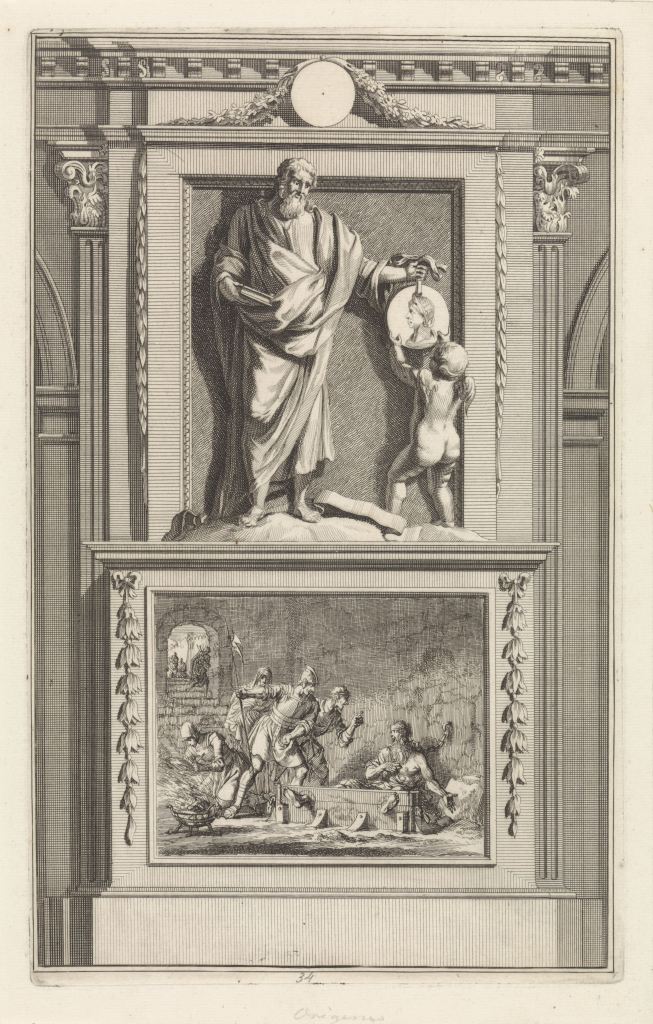
Under the Roman emperor Decius, who is famous for his foul persecutions of Christians, Origen was imprisoned and subjected to terrible tortures.
Eusebius describes:
“But how many and how great things came upon Origen in the persecution, and what was their final result—as the demon of evil marshaled all his forces, and fought against the man with his utmost craft and power, assaulting him beyond all others against whom he contended at that time—and what and how many things he endured for the word of Christ, bonds and bodily tortures and torments under the iron collar and in the dungeon; and how for many days with his feet stretched four spaces in the stocks he bore patiently the threats of fire and whatever other things were inflicted by his enemies; and how his sufferings terminated, as his judge strove eagerly with all his might not to end his life; an of what words he left after these things, full comfort to those needing aid, a great many of his epistles show with truth and accuracy [the epistles that described his torment have been lost].”
Church History, VI.39.5, Eusebius of Caesarea (d. 339.)
Note that Origen was not killed, but that his captors hoped he would apostatize just for the sheer damage such an event would have on Christianity, were such a mighty teacher were to renounce his faith, yet he never did. And although Origen survived, we know that he desired martyrdom even from youth, and he endured such tortures without renouncing Christ. A holier confessor is scarcely to be found, even if he did not die on the floors of a Roman prison.
Origen After Origen
Origen‘s influence did certainly not end with his death. We have already seen that St. Pamphilus and Eusebius produced apologia in his name. Further, in the 4th century, Saints Basil the Great and Gregory Nazianzen would compile the Philocalia, a substantial anthology of passages from Origen that they considered of utmost use to students. After Basil’s death, Gregory sent Theodore, bishop of Tyana, a copy of this anthology “as a remembrance of me and f the holy Basil.” A keepsake of the two friends and their shared study of Origen. [Gregory of Nazianzus, Letter 115.]
Even Jerome, during the anti-Origenist period of his life, could still admit that Origen had “surpassed all other writers.” [Jerome, Letter 84, 8.]
We see that even as the Church moves away from Origen‘s speculative theology they still continued to think with the tools he had handed them through his works.
“Anathema to Origen”
It is commonly assumed today that Origen was condemned principally for his doctrine of apokatastasis, a form of purgational universalism in which every rational creature would eventually be reunited with God (this is a similar belief to that of ibn ‘Arabi). While this was prominent among the concerns of the 6th century Church, when it came to Origenism, it was not the only issue. During earlier anti-Origenist controversies, his subordinationist account of what became the mature doctrine of the Trinity was treated as deeply problematic. Any of Origen‘s opponents writing after Nicaea could represent his theology as anticipating Arianism, and they did indeed use this to discredit him. Modern academics especially recognize the significance of subordinationism in his final condemnation, though it was not spoken about so openly then, during the reign of Justinian.
Going forward, we should distinguish at least three things that underwent anathematization at the 2nd Council of Constantinople in 553 A.D.
- Origen Himself
- Origenism — a family of movements that developed and sometimes radicalized doctrines associated with him.
- The sixth-century Palestinian Origenists against whom the ecumenical council was raised.
In 543, Emperor Justinian sent an edict against Origen to Menas of Constantinople. By the time of the council itself, fifteen detailed anathemas were given pertaining to various different beliefs associated with Origenism. These included condemnations of his belief in the pre-existence and fall of rational souls, unusual accounts of the Resurrection, and the doctrine of apokatastasis aforementioned.
While these are not in the texts we receive of the council directly, Origen is named as follows:
“If anyone does not anathematize Arius, Eunomius, Macedonius, Apollinaris, Nestorius, Eutyches and Origen, as well as their impious writings, as also all other heretics already condemned and anathematized by the Holy Catholic and Apostolic Church, and by the aforesaid four Holy Synods and [if anyone does not equally anathematize] all those who have held and hold or who in their impiety persist in holding to the end the same opinion as those heretics just mentioned: let him be anathema.”
Second Council of Constantinople, Anathema 11 (553).
While some people dispute these texts it is undeniable that Origen‘s own anathematization was at least solidified in later councils.
Was His Anathematization Nonsensical?
If the anathema of the Church against Origen is taken to mean that Origen was (wholesale) an enemy of the apostolic faith, whose theology is alien to the Christian tradition, with no authority whatever inside of it, then this interpretation cannot be granted.
We have seen that the Church of Origen‘s day committed to him the care of catachumens, sent for him to decide ecclesiastical quarrels, requested him to preach to bishops and congregations, and that a host of renowned saints and martyrs formed in his school. Bishops travelled just to learn from him. St. Gregory Thaumaturgus credited him with imparting a unique and even divinely inspired understanding of the scriptures. Pamphilus the martyr was among his staunch defenders. Even Jerome, one of his foremost opponents, could not help but sing his praises.
We should not find the Church consistently relying on his methods and revering his students while at the same time speaking as if Origen himself was some alien poison who polluted Christianity.
In particular, from the Akbarian point of view, Origen‘s eternal Logos theology helps demonstrate how one might exalt Christ above all creation and yet confess the Father as the one supreme God.
“Grant that there may be some individuals among the multitudes of believers who are not in entire agreement with us, and who incautiously assert that the Saviour is the Most High God; however, we do not hold with them, but rather believe Him when He says, ‘The Father who sent Me is greater than I.’ (John 14:28)”
Contra Celsum, VIII.14, Origen (d. c. 253).
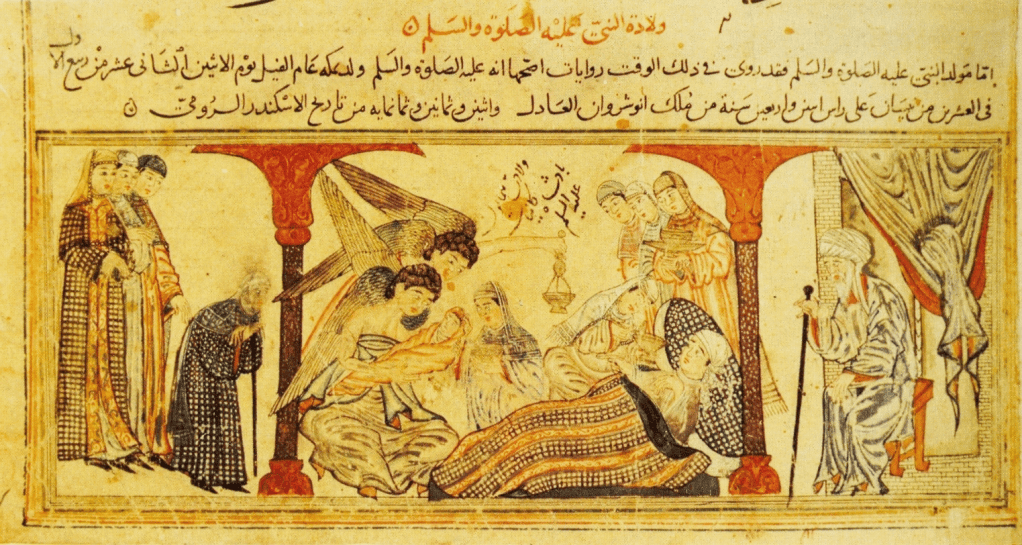
Origen, it has been demonstrated, cannot be dismissed. He was one of the architects of the Christian faith as we know it, and the attempt of the Church to anathematize him while yet inhabiting the structure he helped to bring up will always remain one of the most radical contradictions in Christian history, and I argue, one of the reasons why Muhammad ﷺ had to be sent. Indeed, it was only 17 years after Origen‘s unjust anathematization that he was so gloriously born.