Originally, I intended on writing this article as a means to properly portray the view of Ahlul Sunnah of this important event in islamic history. I’ve noticed that some Shiites may misrepresent the Sunni perspective to strengthen their own. However, even if the Shiite interpretation of the Battle of Camel were accurate, it would not validate their doctrine of Imamate. This just illustrates that Shiite polemicists often present arguments hoping something will eventually stick, which unfortunately, sometimes happens when the person they are discussing with is not well-informed. In the words of Rene Guenon:
“…instead of attempting to raise himself to truth, seeks to drag truth down to his own level.”
However, I came across a debate between Sami Zaatari and David Woods, where David Woods argued that the Battle of the Camel resulted from the teachings of the Prophet (upon whom be peace) and that Islam inherently encourages such violence. Although this argument seems unique to David Woods, I find it ridiculous enough to warrant clarification. It is important to note that when a lie is propogated enough, people begin to take it as fact, in the words of one of the greatest Arab Anthropologist:
“The more a supposed ‘incident’ becomes popular, the more a network of unfounded tales and stories is woven around it.”
Ibn Khaldun
Additionally, since this perspective overlaps with the Shiite view, I aim to refute both positions in this article.
This article will be divided into 6 parts:
David Wood’s Argument
Who is Abdullah ibn Saba and the assassination of Uthman ibn Affan
Imam Al Nawawi’s view on the conflict.
Al Tijani’s claims about Aisha
Some inconsistiencies in the Shiite narrative
Who killed Ammar ibn Yasir?
Conclusion
David Wood’s Argument
To begin, even if we were to assume that David Wood’s argument is true, how could one argue that this was due to the teachings of the Prophet Muhammad (upon whom be peace) when narrations from even the authority of Sahih al-Bukhari have claimed that he said:
While I was going to help this man (‘Ali Ibn Abi Talib), Abu Bakra met me and asked, “Where are you going?” I replied, “I am going to help that person.” He said, “Go back for I have heard Allah’s Messenger (upon whom be peace) saying, ‘When two Muslims fight (meet) each other with their swords, both the murderer as well as the murdered will go to the Hell-fire.’ I said, ‘O Allah’s Messenger (upon whom be peace)! It is all right for the murderer but what about the murdered one?’ Allah’s Messenger (upon whom be peace) replied, “He surely had the intention to kill his companion.”
Sahih al-Bukhari 21
More importantly, this view is not even true, if it was, then the Twelver view of this event would be the accurate one, which we will soon see is not even remotely the case. It is only due to the ignorance of Twelvers and critics of Islam that they believed that Ali and Aisha wanted to fight each other (may peace and blessings be upon them both). One of the most common arguments in regards to Aisha (upon her be peace) is that she left her home to fight Ali (upon him be peace), when in reality, both of them were innocent in the conflict, and the real culprits were in fact the “Shias of Ali” who, historically, were known for being the cause of many conflicts.
Who is Abdullah ibn Saba and the Assassination of Uthman
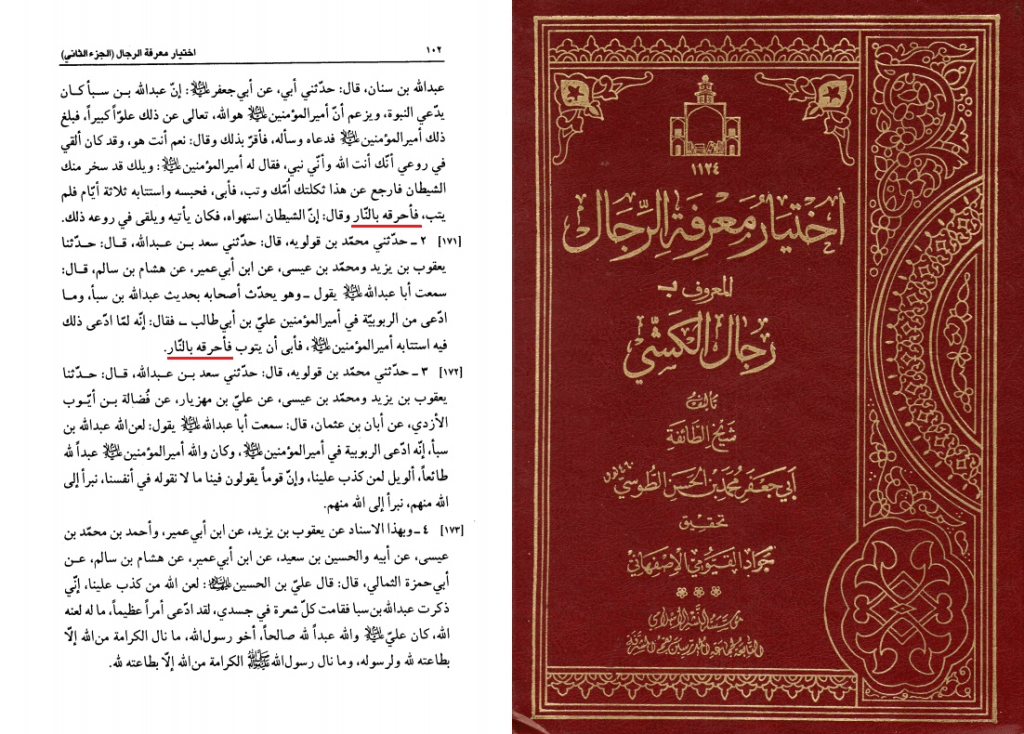
The entire conflict of The First Fitna occured because of the tragic demise of the third rightful caliph Uthman ibn Affan (upon him be peace). In the last few years of Uthman’s reign, signs of turmoil in Muslim society started to surface, brought about by some changes done in Uthman’s reign. Some instigators used this opportunity to pretend to be muslim to cause conflict, one of these people was a Yemeni Jew by the name of Abdullah ibn Saba. There is no denying that such a person existed, Al-Khoie quotes from Kashshi’s Rijal, p. 107, hadith no. 171 with one of the most sound chains you can get, it is not an isolated report:
1.) حدثني محمد بن قولويه، قال حدثني سعد بن عبد الله، قال حدثنا يعقوب بن يزيد و محمد بن عيسى، عن ابن أبي عمير، عن هشام بن سالم، قال : سمعت أبا عبد الله (عليه السلام) يقول و هو يحدث أصحابه بحديث عبد الله بن سبإ و ما ادعى من الربوبية في أمير المؤمنين علي بن أبي طالب، فقال إنه لما ادعى ذلك فيه استتابه أمير المؤمنين (عليه السلام) فأبى أن يتوب فأحرقه بالنار.
Hisham bin Salim, who said that he heard it from Abi Abdillah (Ja’far Al-Sadiq) when he told that Abdullah bin Saba’ called (to people) the lordship/divinity of the Chief of the Believers, ‘Ali. Upon that ‘Ali ordered him to repent, but he refused. Then ‘Ali let him burn in fire.”
Kashshi’s Rijal, p. 107, hadith no. 171, Sahih (Authentic) to Al- Khoie
In al-Khiṣāl, al-Qummī narrated the same report, but in connection with a different chain of narration. The author of Rawḍāt al-Jannāt mentioned ibn Saba’ in a quotation from Imām al-Ṣādiq (upon him be peace), who cursed ibn Saba’ and accused him of lying, fabricating, broadcasting secrets and misinterpreting. He is also mentioned in a plethera of Sunni sources as well.1
His role in the conflict is undeniable, as noted in history books such as Tarikh al Tabari. For instance, it is transmitted that Abdullah ibn Saba would decieve people by means of letters that he claimed to have received from the senior companions, inciting the people against Uthmān.2 Scholars such as ibn-Kathir and Al-Dhahabi were of the view that ibn Saba started the conflict in Egypt, in which he planted the seeds of anger towards the government. 3
After Uthman’s assassination, it is very clear that Ali was extremely angry with the events leading up to the conflict, however, it must be noted that the events of the conflict were not black and white, as Al-Nawawi writes. This is even recorded in Nahjul Balagha, which the Twelvers consider authentic.4
“You should know that you have again reverted to the position of the [pagan] Bedouin Arabs after immigration to Islam, and have become different Shias after having been once united. You do not possess anything of Islam except its name, and know nothing of belief save its show. You would throw down Islam on its face in order to defame its honor and break its pledge for brotherhood which Allah gave you as a sacred trust on His earth and a source of peace among the people.You have broken the shackles of Islam, have transgressed its limits, and have destroyed its commands!”
“Leave me and seek someone else. We are facing a matter which has (several) faces and colors, which neither hearts can stand nor intelligence can accept. Clouds are hovering over the sky, and faces are not discernible. You should know that if I respond to you I would lead you as I know and would not listen to the utterance of any speaker or the reproof of any reprover. If you leave me then I am the same as you are. It is possible I would listen to and obey whomever you make in charge of your affairs. I am better for you as a counselor than as chief.”
“O my brothers! I am not ignorant of what you know, but how do I have the power for it while those who assaulted him are in the height of their power. They have superiority over us, not we over them. They are now in the position that even your slaves have risen with them and Bedouin Arabs too have joined them. They are now among you and are harming you as they like. Do you see any way to be able to do what you aim at.”
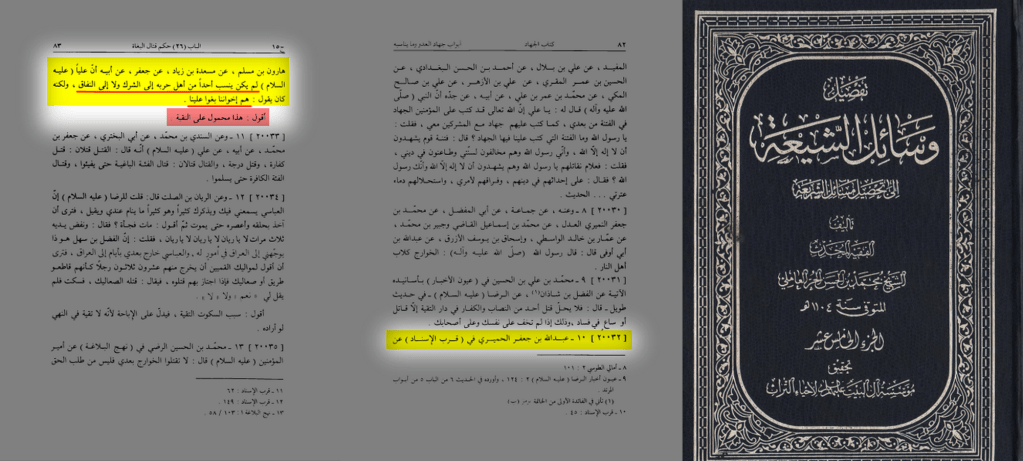
To this end, it is also important to recognize that Shi’ism started as a political group and was not recognized as a sect during the time of Ali ibn Abi Talib. The fourth caliph himself confessed that those whom he was in disagreement with (i.e. Muawiya ibn Abu Sufyan’s army) were upon the same religion as him.
Harun bin Muslim, on the authority of Masada bin Ziyad, on the authority of Jaafar, on the authority of his father, that Ali (upon whom be Peace) He did not attribute any of the people of his war to polytheism or hypocrisy, but he He used to say: “They are our brothers who have wronged us.”
Ibn Taymiyyah (a man whom the Twelvers accuse of being anti-Ahlul Bayt) wrote:
Each of the two groups confirmed that Muʿāwiyah I was not as qualified as ʿAlī I with regard to being khalīfah, and that he could not be khalīfa when it was possible to appoint ʿAlī I to that position. ʿAlī’s superiority, seniority, knowledge, religious commitment, courage and all his virtues were obvious and well known to him, as was also the case with regard to his fellow khulafā’ Abū Bakr, ʿUmar and ʿUthmān
Majmūʿ al-Fatāwā, vol. 35 p. 72
There is no disagreement among any scholar of Islam that this conflict did not occur because people rejected the caliphate of Ali ibn Abi Talib, rather ; the difference was only concerning the issue of bringing the murderers of ʿUthmān to justice.
Imam Al-Nawawi’s view on the conflict
Imam Al-Nawawī said:
It should be noted that the reason for these battles was that the issues were not clear. Because they were so unclear, they held different views, and three groups emerged:
A group whose view was that one party was in the right, and that those who differed with them were transgressors; they thought that they had to support this party and fight the transgressors, according to what they believed, and that it was not permissible for the one who reached that conclusion to withhold help and support from the leader who was in the right by fighting the transgressors, according to this belief;
A group that held the opposite view; they thought that the other party was in the right, so it became obligatory for them to support that party and fight those who transgressed against them
A third party that was undecided about the issue and confused about it and did not reach any conclusion as to which party was more in the right; they kept away from both and believed that this staying away was what they were required to do with regard to this situation, because it was not permissible for them to help anyone in fighting other Muslims unless it was clear to them that they deserved to be fought, and that if they concluded that one of the two parties was closer to the right, it would not be permissible for them to withhold their support in fighting the transgressors.
Sharḥ al-Nawawi ʿalā Ṣaḥīḥ Muslim, vol. 15 p. 149.
Al Tijani’s claims about Aisha
There is a particular book on my bookshelf that my father gave me to read when I first expressed my doubts about the Twelver doctrine, it was written by a Tunisian man by the name of Muhammad al-Tijani, a man who converted from Sunni Islam to Twelverism. In his book “Then I was Guided”, he writes:
“We may ask a few questions about the war of al-Jamal, which was instigated by Umm al-Mumineen Aishah, who played an important role in it.how could Aishah allow herself to declare war on the caliph of the Muslims, Ali Ibn Abi Talib, who was the master of all Muslims? As usual, our scholars, with some simplicity, answer us that she did not like Imam Ali because he advised the Messenger of Allah to divorce her in the incident of al-Ifk.”
Al Tijani’s Then I was Guided, p. 117
This view is exceedingly weak, even without delving into historical analysis. To claim that Aisha (upon her be peace) incited the battle out of pettiness and hurt feelings is entirely irrational and illogical. In reality, Islamic history was not a Disney movie with villains whose only motive was to be evil.
Al-Tabari narrates that Uthman ibn Hunayf, who was Ali’s governor of Basra sent word to Aisha when she arrived in Basra, asking why she had come, to which she replied:
“By God, a woman in my position should not go out on a campaign without having a clear reason and making it clear to her children (meaning the Muslims). The thugs of various cities and tribes have invaded the sanctuary of the Messanger of God and have committed a great deal of wrong doing there, and they have offered refuge to the wrongdoers. Therefore they deserve the curse of God and of His Messanger, as they killed the leader of the Muslims for no reason. They shed blood unlawfully, stole ḥarām wealth and violated the sanctity of the sacred land and the sacred month. They transgressed against honour and killed troops. They settled in the place of people who did not want them to settle among them; they caused a great deal of harm but did not bring any benefit. I have come out among the Muslims to inform them of what these people have done, and of the pain and suffering of the people we have left behind, and to tell them (the Muslims) what they should do in order to help set things straight.”
Tarīkh al-Ṭabarī, vol. 5 p. 489.
It is also narrated that Aisha recited Surah al-Nisa verse 114.
Ibn Hibban narrates that Aisha writes to Abu Musa al Ashari (upon him be peace), who was the Governor of Kufa at the time:
You know about the murder of ʿUthmān, and I have come out to set things right among the people. Tell the people in your city to stay in their houses so that we can achieve what they like of setting the Muslims’ affairs straight.
Ibn Ḥibbān: al-Thiqāt, vol. 2 p. 282.
The Great Scholar Ibn al Arabi writes on this matter and mentions:
As for her going out to the Battle of the Camel, she did not set out to fight, but the people pinned their hopes on her8 and complained to her about how bad the turmoil and confusion had become. They hoped by her blessing to set things straight and that the people would show respect for her and comply when she took a stance among them. She also thought that herself, so she set out in compliance with the words of Allah: [Ibn al Arabi quotes Surah al-Nisa verse 114]
The command to reconcile between people and set things straight is addressed to all people, male or female, free or slave.
Aḥkām al-Qur’ān, vol. 3 p. 569, 570.
Ibn al Arabi’s view also aligns with what Al Tabari and Ibn Abi Shaybah narrate:
“And the people who provoked the murder of Uthman [the Saba’ites] had the worst sleep ever because they came close to be doomed. They were discussing their plight the whole night until they agreed to ignite a war [between Aisha and Ali] in secret. They took that as a secret so that no one would know what evil they were planning. They woke up at dusk and while their neighbors did not feel them; they (the agitators) sneaked to do the dirty job in the darkness . they laid swords in the believers.”
Al-Tabari, vol.3, p.39
“The Saba’ites.who were fearing of peace.started throwing Aisha with lances while she was on her camel. Aisha said: ‘Remember Allah and Judgment Day.’ But the Saba’ites refused anything but to fight. So the first thing Aisha said when the Saba’ites refused to stop was: ‘O people, curse the killers of Uthman and their friends.'”
Musnaf Ibn Abi Sheibah, vol.8, the Book of the “Camel” in the departure of Aisha, p.718
And so, what we see here is that the Battle of The Camel was was initiated not by Aisha or Ali (upon both be peace), but by the Sabaites who attacked Aisha’s envoy for fear that her negotiation mission would succeed and result in the subsequent capture of those responsible for the death of Uthman (upon him be peace). As a result of this, Ali, Aisha, Talha, and Zubair (upon them be peace) ound their contingents fighting each other, not even knowing who fired the first shot.
We know how this stories plays out, the Sabaites blamed the entire operation on the Mother of the Believers and we see clearly today that their descendants: the Twelver Shia have continued this tradition of blaming Aisha for something that their forefathers were responsible for.
Next, Al-Tijani writes:
“How could Umm al-Mu’mineen Aishah leave her house in which Allah had ordered her to stay, when the most High said: ‘And stay in your houses and do not display your finery like the displaying of the ignorance of yours.’ (Quran, Verse 33:33)”
Al Tijani’s Then I was Guided, p. 117
We seek refuge in God from such slander of the chastity of the Prophet’s beloved wife. God’s command for women to stay in the house was directed not only at the Prophet’s wives but at all women in general. This directive does not mean that women are never allowed to leave the house; rather, it serves as a guideline to help maintain their chastity and modesty.
Some inconsistiencies in the Shiite narrative
Let us suppose for a moments time that it had been Abu Bakr (upon him be peace) or Umar (upon him be peace) who had delayed enacting justice for Ali’s hypothetical murderers, then the Twelvers would slander Abu Bakr and Umar for these actions. As we have seen, to the Twelvers, it is not the actions that are commited, but rather who takes those actions. If Ali does something, it must be right, if Muawiyah (upon him be peace) does something, it must be wrong. If we were to swap the places of Ali and Aisha to Abu Bakr and Fatima (upon them be peace), then suddenly, the Twelvers would not use this as evidence against Fatima but rather against Abu Bakr.
I say: Although unrelated to the original purpose of this article, another Twelver misconception of the beloved wife of the Prophet (upon whom be peace) is that she poisoned him, and his cause of death was because Aisha (upon her be peace) slipped poison into his medicine. We seek refuge from God from such disgusting lies upon the loved ones of the Prophet. The problem with this view is very simple: it is established that Ali (upon him be peace) confronted Aisha after the battle of the Camel. Let us recall that the punishment of murdering anyone (let alone the Prophet of God) is capital punishment, so I ask the Twelvers who believe such nonsense: why did Ali ibn Abi Talib not punish Aisha for this crime that she allegedly commited? Islamically, is anyone ever in the right to excuse a person for this crime if they so wish?
Some Twelvers even make the claim that Aisha was complicit in the murder of Uthman and that she used it as an excuse to fight Ali, which is an extremely weak argument for a number of reasons:
The First Issue: It is undeniable that there were hundreds of people protesting on the streets, all demanding justice for the murder of Uthman. The majority of these people were from the same tribe as Uthman (i.e. Muawiyah ibn Abu Sufyan). It begs the question: if Aisha had publically advocated Uthman’s murder and she was complicit in his murder, then why would she later be “allied” with Muawiyah ibn Abu Sufyan?
The Second Issue: A Twelver might argue that Muawiyah and Aisha shared the same motive: both hated Ali and desired the position of power for themselves. However, I question this view. If Muawiyah were as power-hungry as the Twelvers depict, why would he be complacent regarding Aisha’s alleged involvement in the murder, especially when the Twelvers claim that Uthman exhibited nepotism towards his own tribe?
The Third Issue: Is it really believable that hundreds of people would fight against the Shia’t Ali, simply because Aisha’s feelings were hurt over an incident that took place years before? It should be noted that this story that Al-Tijani quotes is a blatant forgery, as are almost all stories that the Twelvers believe about Aisha.
Who killed Ammar ibn Yasir?
Ammar ibn Yasir (upon him be peace) was an illustrious companion of the Prophet of God (upon whom be peace). His father Yasir and his mother Sumayyah were marytred by Abu Jahl. He was so beloved by the Prophet (upon whom be peace) that it was narrated in Sahih al-Bukhari on the authority of Ikrama:
“…The Prophet (upon whom be peace) passed by `Ammar and removed the dust off his head and said, “May God be merciful to `Ammar. He will be killed by a rebellious aggressive group. `Ammar will invite them to (obey) God and they will invite him to the (Hell) fire.”
Sahih al-Bukhari 2812
Twelver polemicists love to quote this narration as means to claim that it refers to the army of Muawiyah ibn Abu Sufyan, who was “inviting” Ammar ibn Yasir to hellfire. In reality, as we shall soon see, Ammar’s murderers were none other than the Saba’iyyah rebels who were also responsible for the assassination of Uthman ibn Affan.
The First Issue: Ibn Hajar al Asqalani writes:
Shabath ibn Rabʿī al-Tamīmī al-Kūfī was a mukhadram (he was born in the pre-Islamic era but only embraced Islam after the demise of the Messanger of God). He was the muʿadhin of Sajjāh (the lady imposter who claimed prophethood after the demise of the Prophet). He then accepted Islam and went on to assist in the murder of ʿUthmān. Thereafter he joined the ranks of ʿAlī (on the occasion of Ṣiffīn he came as an envoy to Muʿāwiyah and claimed that Ammār was one of the killers of ʿUthmān) and then joined the Khawārij. He then repented, and would be among those who invited Ḥusayn ibn Ali (to Kūfah) but joined the army that fought and killed him. Subsequently, he joined Mukhtār al-Thaqafī and fought to avenge the death of Ḥusayn. He was appointed as a police officer in Kūfah and later assisted in the killing of Mukhtār al-Thaqafī. He eventually died in Kūfah in 80 A.H.
It follows that the companions in Muāwiyah’s army did not intend to kill ʿAmmār. Instead, it was the scheme of the ignorant Sabaʼiyyah, who accused ʿAmmār of instigating against ʿUthmān and therefore held him responsible for his murder. The actual culprits are those who brought him to that point, similar to a false witness or a judge who accepts a bribe.
The Second Issue: According to a famous narration of ʿAmr ibn al-ʿĀs, the killer of ʿAmmār and the one who takes possession of his belongings is destined for hellfire.10 So the narrator of this hadith is non other than a high ranking military officers of Muawiyah’s army, the people who allegedly were the transgressors that would invite Ammar ibn Yasir to hellfire.
The Third Issue: The narrations found in both Sunni and Shi’ite literature regarding the methods of Abdullah ibn Saba and his followers in inciting rebellion against Uthman shed light on a new possibility: it was these very Sabaʼiyyah who took advantage of ʿAmmār’s old age and held him back. They even invited him to rebel against and kill ʿUthmān; in other words: “They were inviting him to hellfire.”
Conclusion
I conclude with some important remarks and a critical question
If the ruler of Syria (Muawiyah ibn Abu Sufyan) had submitted, would it have brought about peace?
If Muʿāwiyah had accepted his dismissal as the ruler of Syria and pledged allegiance to ʿAlī, would this have satisfied the rebels? Would they have handed over ʿUthmān’s killers to ʿAlī? Would the murderers then have been executed, leading to the unification of the Islamic world? Any logical person would say no, in fact, it is much more likely that the rebels would then cause dissension and disunity amongst the ranks of ʿAlī’s army, as they did on the occasion of arbitration. It was due to conflicting viewpoints and the plotting of the rebels11 that no reconsiliation could be reached, and further battle was unavoidable.
Imam Bukhari writes:
Whoever finds fault and criticises Muawiyah and ʿAmr ibn al-ʿĀs (as well as Talha, Zubayr, ʿĀʼishah and Mughīrah ibn Shuʿbah, who are superior han them in rank), his heart is sick and he is classified as a Rāfiḍī. (Rejector)
Al-Bidāyah wa al-Nihāyah vol. 8 pg. 139
The reality of the situation was not completely straightforward, but what we do know for certain is that all Aisha, Talha, Zubayr, and Muawiyah wanted was for Ali to apprehend Uthman’s killers, who were among his supporters. Ali had always planned to do this, and it is likely that he would have agreed to Aisha’s request to expedite the process. This is precisely why the killers of Uthman attacked Aisha’s enjoy as per the narrations in Tarikh al Tabari and Musnaf Ibn Abi Sheibah. It is indeed the characteristics of the hypocrites to accuse the believers of having alterior motives. Was it not the polytheists of Quraysh who accused the Prophet of trying to gain materialistic wealth? Was it not the hypocrites who accused Uthman of nepotism? Was it not the hypocrites who accused Ali of taking the caliphate after supposedly killed Uthman? And is it not the Twelvers who, to this day, accuse take the actions of the wife of the Prophet and accuse them of having ill-motives.
The following are some beneficial books I would recommend regarding the righteous companions of the Prophet (upon whom be peace) and some important events regarding their lives:
Ibn Ḥajar: Lisān al-Mizān, vol. 3 p. 360., Abū Ḥātim: al-Mujrūḥīn min al-Muḥaddithīn, vol. 2 p. 253., Tadhkirat al-Ḥuffāz, vol. 2 p. 551; Shadharāt al-Dhahab, vol. 2 p. 129., Al-’Awdah: ʿAbd Allāh Ibn Saba’, p. 53; Ibn Habīb: al-Muḥbar, p. 308. ↩︎
The people alive during the battle of the Camel respected Aisha (RA), being the lover and widow of the holy Prophet (SAW), as such, people would listen to her. It was not at all strange that she would think to use her influence to end the conflict between the Muslims ↩︎
This is backed up by what is narrated in Tārīkh al-Ṭabrī vol. 4 pg. 2, 3 ↩︎
For example, It is reported in Tārīkh al-Ṭabrī, ibn al-ʿAthīr, ibn al-Khaldūn and Siyar al-Ṣaḥābah that Ashtar al-Nakhaʿī repeatedly rebuked Jarīr ibn ʿAbd Allāh and disrespected him to such an extent that Jarīr – who was one of the governors of ʿAlī – eventually left the army. ↩︎
 Mehdi's Library
[…] See also: Clarification on the Battle of the Camel […]
LikeLike
The prophet صلى الله عليه و سلم said the killer of the son of Saffiya is in hell. (It is also in Shia books).
yet no one claims Ali is in hell
LikeLike