Firstly, there are two very important things to clarify. There is a very important distinction to be made between Microevolution and Macroevolution. Microevolution is the change in allele frequencies that occurs over time within a population. This change can be due to multiple reasons, but one of the most common reasons is because of natural selection. An example of observable microevolution in recent history is the peppered moth. It was an evolutionary instance of directional colour change in the moth population as a consequence of air pollution during the Industrial Revolution. More specifically, the frequency of dark coloured moths increased exponentially and when pollution was reduced, the light-coloured form again predominated. This phenomemon is common referred to as Industrial melanism.
Below I have provided an interesting paper on industrial melanism and the phenomenon of the peppered moth:
However, this article will not be about microevolution, as microevolution is undeniably not in conflict with Islam, rather, I wish to speak about macroevolution, a much more controversial and complex topic.
The second thing I wished to clarify is in reference to the March of Progress, a very population illustration that attempts to presents 25 million years of human evolution. However, this illustration is inaccurate, as evolutionary biologists do not believe that human beings evolved from monkeys and/or apes.
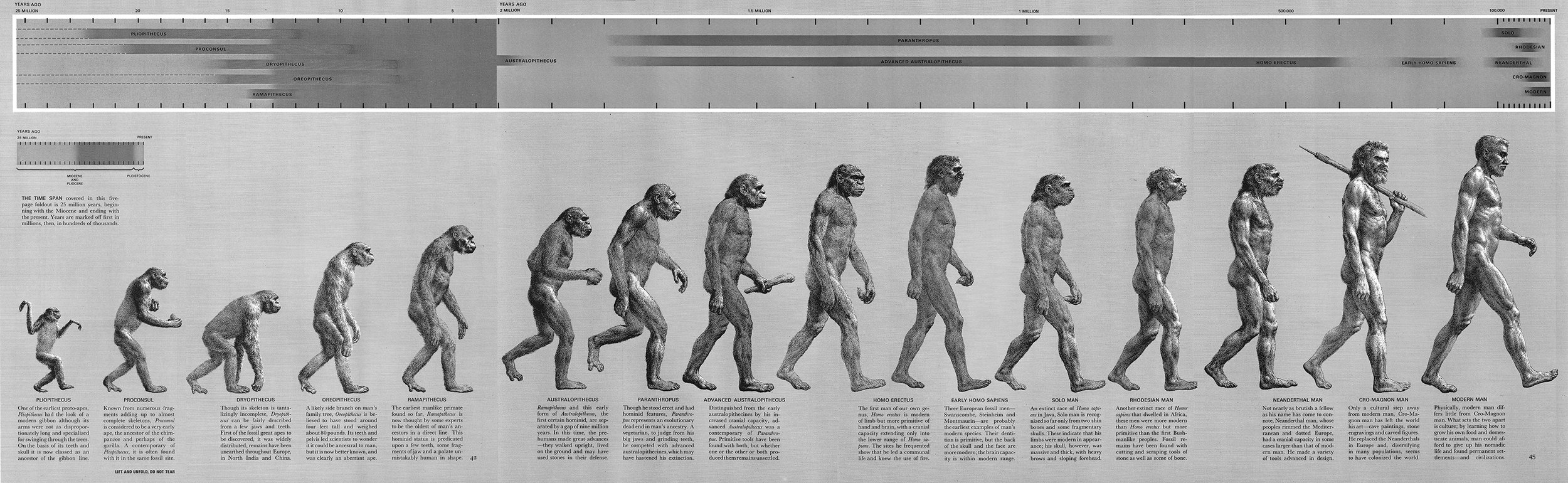
According to evolutionary biology, humans and monkeys are part of the order Primates. The theory suggests that humans share a common ancestor with other primates, such as chimpanzees, gorillas, and monkeys, but humans did not evolve directly from monkeys. Instead, humans and monkeys both evolved from a now-extinct species that existed millions of years ago. This is precisely what macroevolution is, rather than the change of allele frequency, macroevolution means the evolution of large-scale structures and traits that go significantly beyond the intraspecific variation found in microevolution.
Before I begin with the topic of this article, I wish to clarify my own stance: I am absolutely agnostic on this position and do not hold one belief any stronger than the other. To be more specific, the “evolution” in question that this article is referring to is the belief that humans evolved from a common ancestor that we share with the chimpanzee. As always, God knows best.
This article will be divided into 5 parts:
- Who discovered Macroevolution?
- An example of Macroevolution (The Evolution of Viviparity in Lizards)
- Macroevolution and the Quranic/Genesis account
- Macroevolution and the reflection of a single origin
- Conclusion
Who discovered Macroevolution?
A common misconception many people have about evolution is that it was independently discovered by Charles Darwin, an atheist. However, this statement is slightly incorrect. Although it is true that Charles Darwin solidified the evolutionary model that many are proponents of today, Jean-Baptiste Lamarck, a French Naturalist was the first person to discover the basic principals of evolution. Lamarckian evolution was discovered when Lamarck had the idea to apply the principle of erosion to biology. Although we have established today that Lamarckian evolution is slightly inaccurate, it is important to note that the idea that all species evolved from simpler lifeforms over long periods of time.
In his book Philosophie zoologique, Lamarck referred to God as the “sublime author of nature”, and Alpheus Packard suggested that Lamarck may be regarded as a deist. Here is one very nice exerpt from Philosophie zoologique:
“That the natural order of animals constitutes a series, which we should traverse from the most imperfect animals to the most perfect, in order to be in harmony with the order of Nature; for Nature did not bring them all into existence at the same moment. Since she had to form them in turn, she was obliged to begin with the simplest, and only produced at the end those with the most complex organisation.”
“If indeed it is true that all living bodies are productions of nature, we are driven to the belief that she can only have produced them one after another and not all in a moment. Now if she shaped them one after another, there are grounds for thinking that she began exclusively with the simplest, and only produced at the very end the most complex organisations both of the animal and vegetable kingdoms.”
Jean-Baptiste Lamarck’s. Philosophie Zoologique (1809)
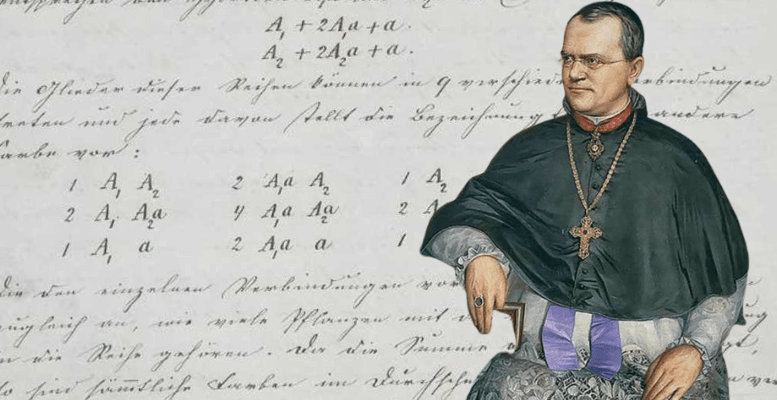
Another significant figure who reinforced evolutionary biology was the great Augustinian priest, Gregor Mendel. To keep this section concise, I will simply include a reference to another paper that discusses Gregor Mendel’s contributions to evolutionary biology.
Lastly, and most importantly, the great Ibn Khaldun writes in his Muqaddimah the following:
“One should then take a look at the world of creation. It started out from the minerals and progressed, in an ingenious, gradual manner, to plants and animals. The last stage of minerals is connected with the first stage of plants, such as herbs and seedless plants. The last stage of plants, such as palms and vines, is connected with the first stage of animals, such as snails and shellfish which have only the power of touch. The word ‘connection’ with regard to these created things means that the last stage of each group is fully prepared to become the first stage of the newest group. The animal world then widens, its species become numerous, and, in a gradual process of creation, it finally leads to man, who is able to think and reflect. The higher stage of man is reached from the world of monkeys, in which both sagacity and perception are found, but which has not reached the stage of actual reflection and thinking. At this point we come to the first stage of man. This is as far as our (physical) observation extends.”
Ibn Khaldun’s Muqaddimah
Note that Ibn Khaldun lived almost 400 years before Lamarck, and held beliefs similar to that of proponents of Darwinian Evolution.
The fact of the matter is simple: there is nothing inherently atheistic about the concept of natural selection or the idea that all living organisms developed from simpler forms over a long period of time. This is evident in the fact that many proponents of these ideas have also held a belief in a higher power.
An example of Macroevolution (The Evolution of Viviparity in Lizards)
Most lizards are egg-laying and thus need an environment that is warm enough to incubate their eggs, however some species of lizards have evolved viviparity. The development of viviparity (live-bearing reproduction) in lizards is a complex evolutionary process that involves significant anatomical and physiological changes. Before this evolutionary shift, lizards were primarily oviparous, meaning they laid eggs that developed outside the mother’s body. For example, the Viviparous lizard is a an example of a viviparous lizard throughout most its range, however, and more interestingly, oviparous in the extreme southwest portion.1 2
The transition to viviparity required several key changes. Initially, lizards were oviparous, relying on external egg-laying with thick shells to protect their developing embryos. However, through gradual evolutionary adaptations, some species began to retain their eggs longer within the body, leading to a reduction in eggshell thickness and the development of simple placental structures for nutrient and gas exchange. This transition eventually led to fully viviparous species. These changes involved adaptations strongly supporting macroevolution by demonstrating how new, complex reproductive strategies can emerge, from considerably more simpler ones (similar to what Lamarck proposed in the 18th century).
Macroevolution and the Quranic/Genesis account
It is important to note that no where in the Quran does it state that Adam and Eve’s progeny were the only humans on earth. Indeed Adam was the first human on earth and was given emphasis and favour in the Quran because he was a prophet of God. In fact, proponents of the belief that Adam and Eve’s progeny were the only human beings on earth have to concede that Adam and Eve’s progeny (such as Cain, Abel, and Seth) had to commit incest to reproduce. Saint Augustine writes in his City of God the following:
As, therefore, the human race, subsequently to the first marriage of the man who was made of dust, and his wife who was made out of his side, required the union of males and females in order that it might multiply, and as there were no human beings except those who had been born of these two, men took their sisters for wives,—an act which was as certainly dictated by necessity in these ancient days as afterwards it was condemned by the prohibitions of religion . . . and though it was quite allowable in the earliest ages of the human race to marry one’s sister, it is now abhorred as a thing which no circumstances could justify.
Saint Augustine of Hippo’s The City of God XV.16
Of course, there isn’t any contradiction in this belief. Ibn Jarir at-Tabari reported that Eve bore Adam one hundred and twenty sets of twins. Ibn Ishaq was quoted as saying that all the children that Hawwa’ bore Adam were forty children, male and female, from twenty twin pregnancies.3
Herein lies the wisdom of divine abrogation, that certain laws specific to a time period can be repealed by a genuine revelation from God when they are no longer applicable. God says in the Quran:
۞ مَا نَنسَخْ مِنْ ءَايَةٍ أَوْ نُنسِهَا نَأْتِ بِخَيْرٍۢ مِّنْهَآ أَوْ مِثْلِهَآ ۗ أَلَمْ تَعْلَمْ أَنَّ ٱللَّهَ عَلَىٰ كُلِّ شَىْءٍۢ قَدِيرٌ ١٠٦
Nothing of our revelation (even a single verse) do we abrogate or cause be forgotten, but we bring (in place) one better or the like thereof. Knowest thou not that Allah is Able to do all things? (2:106)
— M. Pickthall
One might wonder as to why there is so much genetic diversity and so many different shades of skin if we came from Adam and Eve. The reason for this is not as complicated as you may think. The term we are looking for is genetic drift. When a population becomes isolated from others, certain traits can gradually become more dominant within that group over time. Combined with environmental factors such as survival pressures, climate, and available resources, this process leads to differences between populations. Essentially, you could say “Adam and Eve possessed all the genetic material for all races,” and genetic drift, along with these environmental influences, led to the natural development of different races as populations became more isolated from each other (such as Native Americans and Sudanese). As we have previously mentioned, Islamic belief does not hold that humanity is only approximately 6,000 years old, allowing ample room for genetic drift to occur over time.
Alternatively, you could attribute these changes entirely to evolutionary processes, which is precisely what I will get into now.
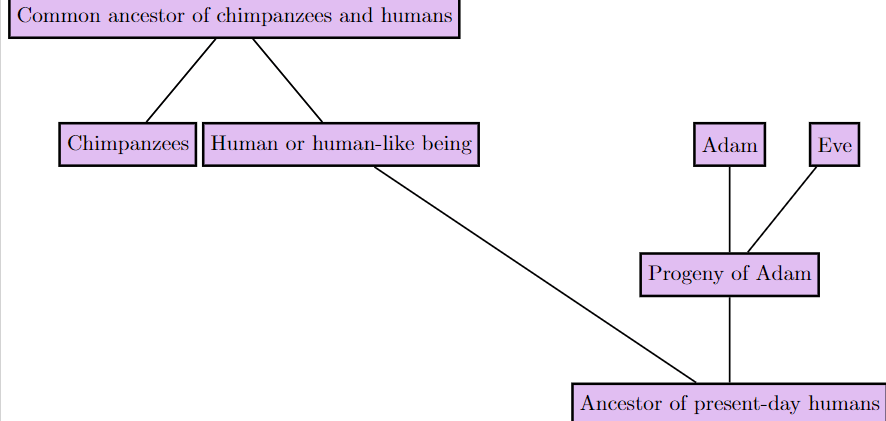
Those who reject the concept of macroevolution at the level depicted in this diagram often overlook the possibility that Adam’s descendants could have interbred with human-like beings who evolved from the common ancestor shared with chimpanzees. This diagram illustrates the theory that all present-day humans not only share a common ancestor with chimpanzees but could also be descendants of a parentless couple (Adam and Eve) created independently. This diagram is compatable with every Hadith and Quranic verse surrounding Adam and Eve.
Some people believe that macroevolution replaces the role of God, but this view overlooks the fact that macroevolution is fundamentally a molecular process. This process depends on the replication of nucleic acids, which in turn relies on the intermolecular and intramolecular forces that govern atomic interactions. These forces are inherent to the properties of elements like carbon, hydrogen, oxygen, and nitrogen—elements that were intricately designed by God. When the Quran says that God creates all living things, it does not preclude the possibility of God creating them through an intermediary process.
Macroevolution and the reflection of a single origin
The main theme of the Quran and of Islam is declaration that There is no deity but God. Anyone who has read the Quran can easily conclude that the main message of the Quran is monotheism. God says in the Quran that he created the entire universe in such a way that it reflects a single origin and leaves no excuses for polytheism.
ٱلَّذِى خَلَقَ سَبْعَ سَمَـٰوَٰتٍۢ طِبَاقًۭا ۖ مَّا تَرَىٰ فِى خَلْقِ ٱلرَّحْمَـٰنِ مِن تَفَـٰوُتٍۢ ۖ فَٱرْجِعِ ٱلْبَصَرَ هَلْ تَرَىٰ مِن فُطُورٍۢ ٣
Who hath created seven heavens in harmony. Thou (Muhammad) canst see no fault in the Beneficent One’s creation; then look again: Canst thou see any rifts? (63:7)
— M. Pickthall
Evolutionary biology aligns closely with the theme of unity, as it demonstrates the interconnectedness of all living things. This supports the Quranic concept that God has manifested monotheism in His creation, reflecting a unified design in the natural world. Another important theme in the Quran is God’s needlessness. Specifically, God does not face limitations or scarcity of resources, so He has no need to prioritize efficiency in His design. Efficiency is only necessary when resources are limited, and there is no reason to believe that God had to be efficient in His creation. This perspective aligns with the concept of gradual modification and macroevolution, which is often seen as an inefficient process.
ثُمَّ خَلَقْنَا ٱلنُّطْفَةَ عَلَقَةًۭ فَخَلَقْنَا ٱلْعَلَقَةَ مُضْغَةًۭ فَخَلَقْنَا ٱلْمُضْغَةَ عِظَـٰمًۭا فَكَسَوْنَا ٱلْعِظَـٰمَ لَحْمًۭا ثُمَّ أَنشَأْنَـٰهُ خَلْقًا ءَاخَرَ ۚ فَتَبَارَكَ ٱللَّهُ أَحْسَنُ ٱلْخَـٰلِقِينَ ١٤
Then fashioned We the drop a clot, then fashioned We the clot a little lump, then fashioned We the little lump bones, then clothed the bones with flesh, and then produced it as another creation. So blessed be Allah, the Best of creators! (23:14)
— M. Pickthall
Perhaps this inefficiency is a reflection of God’s boundless nature and His needlessness.
Conclusion
I believe it is important for me to reiterate again that this article is not a reflection of my personal beliefs. I am not a student of evolutionary biology let alone biology at all.4 The purpose of this article is to demonstrate that macroevolution does not conflict with Islamic beliefs. It is not a challenge that Muslims need to confront, nor does it undermine the Islamic narrative of creation. In fact, even if one accepts that humans share a common ancestor with chimpanzees, and that there has existed a gradual modification of all species, a reflection on the Quran reveals that this process, too, reflects God’s oneness and the unity of all His magnificent creation.
And God guides whom he wills.
- Maria-Jesus Arrayago, et al. “Hybridization Experiment between Oviparous and Viviparous Strains of Lacerta Vivipara: A New Insight into the Evolution of Viviparity in Reptiles.” Herpetologica, vol. 52, no. 3, 1996, pp. 333–42. JSTOR, http://www.jstor.org/stable/3892653. Accessed 28 Aug. 2024. ↩︎
- Guillette, Louis J. “The Evolution of Viviparity in Lizards.” BioScience, vol. 43, no. 11, 1993, pp. 742–51. JSTOR, https://doi.org/10.2307/1312318. Accessed 28 Aug. 2024. ↩︎
- al-Tabari, Muhammad. Tarikh at-Tabari: Tarikh al-Umam wa’l-Muluk. pp. 1/98. ↩︎
- Rather I am a student of mathematics! ↩︎
 Mehdi's Library