وَحَدَّثَنَا مُحَمَّدُ بْنُ الْمُثَنَّى، حَدَّثَنَا مُحَمَّدُ بْنُ جَعْفَرٍ، وَأَبُو دَاوُدَ ح وَحَدَّثَنَا ابْنُ بَشَّارٍ، حَدَّثَنَا يَحْيَى بْنُ سَعِيدٍ، وَمُحَمَّدُ بْنُ جَعْفَرٍ، وَأَبُو دَاوُدَ كُلُّهُمْ عَنْ شُعْبَةَ، عَنْ قَتَادَةَ، عَنْ أَنَسٍ، قَالَ انْشَقَّ الْقَمَرُ فِرْقَتَيْنِ . وَفِي حَدِيثِ أَبِي دَاوُدَ انْشَقَّ الْقَمَرُ عَلَى عَهْدِ رَسُولِ اللَّهِ صلى الله عليه وسلم .
Anas reported that the moon was split up in two parts and in the hadith recorded in Abu Dawud, the words are: ” The moon was split up into two parts during the life of Allah’s Messenger (ﷺ).”
Sahih Muslim 2802c
https://sunnah.com/muslim:2802c
حَدَّثَنَا عَبْدَانُ، عَنْ أَبِي حَمْزَةَ، عَنِ الأَعْمَشِ، عَنْ إِبْرَاهِيمَ، عَنْ أَبِي مَعْمَرٍ، عَنْ عَبْدِ اللَّهِ ـ رضى الله عنه ـ قَالَ انْشَقَّ الْقَمَرُ وَنَحْنُ مَعَ النَّبِيِّ صلى الله عليه وسلم بِمِنًى فَقَالَ “ اشْهَدُوا ”. وَذَهَبَتْ فِرْقَةٌ نَحْوَ الْجَبَلِ وَقَالَ أَبُو الضُّحَى عَنْ مَسْرُوقٍ عَنْ عَبْدِ اللَّهِ انْشَقَّ بِمَكَّةَ. وَتَابَعَهُ مُحَمَّدُ بْنُ مُسْلِمٍ عَنِ ابْنِ أَبِي نَجِيحٍ عَنْ مُجَاهِدٍ عَنْ أَبِي مَعْمَرٍ عَنْ عَبْدِ اللَّهِ.
Narrated `Abdullah: The moon was split ( into two pieces ) while we were with the Prophet (ﷺ) in Mina. He said, “Be witnesses.” Then a Piece of the moon went towards the mountain.
Sahih al-Bukhari 3869
https://sunnah.com/bukhari:3869
حَدَّثَنَا صَدَقَةُ بْنُ الْفَضْلِ، أَخْبَرَنَا ابْنُ عُيَيْنَةَ، عَنِ ابْنِ أَبِي نَجِيحٍ، عَنْ مُجَاهِدٍ، عَنْ أَبِي مَعْمَرٍ، عَنْ عَبْدِ اللَّهِ بْنِ مَسْعُودٍ ـ رضى الله عنه ـ قَالَ انْشَقَّ الْقَمَرُ عَلَى عَهْدِ رَسُولِ اللَّهِ صلى الله عليه وسلم شِقَّتَيْنِ فَقَالَ النَّبِيُّ صلى الله عليه وسلم “ اشْهَدُوا ”.
Narrated `Abdullah bin Masud: During the lifetime of the Prophet (ﷺ) the moon was split into two parts and on that the Prophet (ﷺ) said, “Bear witness (to thus).
Sahih al-Bukhari 3636
https://sunnah.com/bukhari:3636
حَدَّثَنَا مَحْمُودُ بْنُ غَيْلاَنَ، حَدَّثَنَا أَبُو دَاوُدَ، عَنْ شُعْبَةَ، عَنِ الأَعْمَشِ، عَنْ مُجَاهِدٍ، عَنِ ابْنِ عُمَرَ، قَالَ انْفَلَقَ الْقَمَرُ عَلَى عَهْدِ رَسُولِ اللَّهِ صلى الله عليه وسلم فَقَالَ رَسُولُ اللَّهِ صلى الله عليه وسلم “ اشْهَدُوا ” . قَالَ أَبُو عِيسَى وَفِي الْبَابِ عَنِ ابْنِ مَسْعُودٍ وَأَنَسٍ وَجُبَيْرِ بْنِ مُطْعِمٍ . وَهَذَا حَدِيثٌ حَسَنٌ صَحِيحٌ .
Ibn ‘Umar said: “The moon split during the time of the Messenger of Allah(s.a.w), so the Messenger of Allah(s.a.w) said: ‘Bear witness.”‘
Jami` at-Tirmidhi 2182
https://sunnah.com/tirmidhi:2182
Many critics of Islam contend that the event of the moon splitting in two, as described in the Qur’an and Sunnah, lacks historical validation and thus represents a scientific inaccuracy. However, this interpretation is flawed. The essence of a miracle, by its very nature, defies ordinary expectations and consequences. This article will be split into 3 parts:
- Proof from hadith of the moon being split in two
- Do orientalists affirm the reliability of hadith?
- Logical proof for the moon split
- Why did nobody outside of the Arabian Peninsula see it?
Proof from hadith of the moon being split in two
In addition to the aforementioned hadiths above, here is another hadith on the moon being split in two:
“From ‘Abdullah: ‘The moon has split at the time of the Messenger of God (upon whom be peace), so Quraysh has said: “This is the magic of Ibn Abi Kabshah, so they said: ‘wait till the travelers come to you, for Muhammad cannot enchant all of you, then the travelers came and said the same thing -that the moon was split-.’”
Musnad ʾAbī Dāwūd Aṭ-Ṭayālisī (293) [Grade: Authentic (Sahih)]
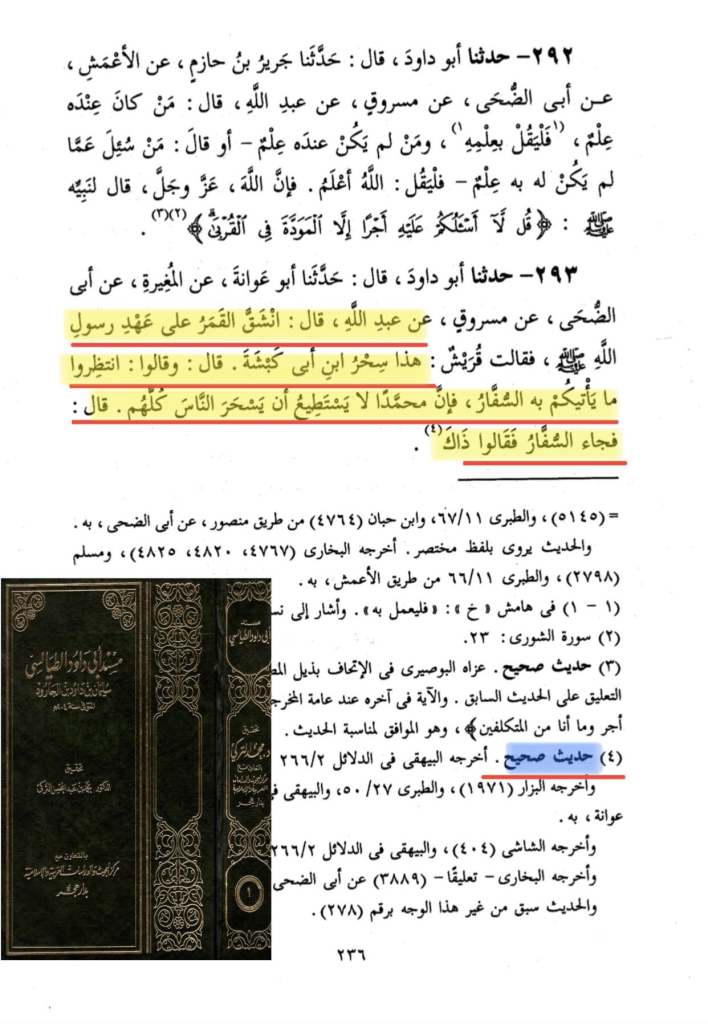
An important detail in this hadith is that it was narrated by Abdullah, who specifies that the polytheistic tribes of Quraysh relied on travelers to testify about what they witnessed. Abdullah’s precise phrasing, “for Muhammad cannot enchant all of you,” suggests that these travelers were also members of the polytheistic tribes. To conclude, it was not the convincing of Muslims that got these polytheistic tribes to believe in the moon split.
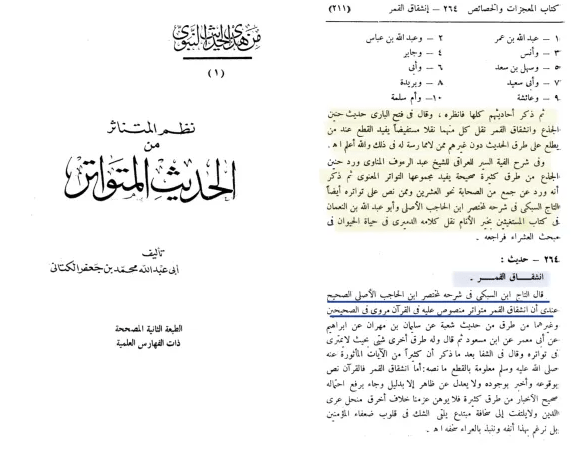
The hadith(s) of the moon split is also graded as mass-transmitted1 (mutawatir)
Do orientalists affirm the reliability of hadith?
Bernard Lewis writes:
“But their careful scrutiny of the chains of transmission and their meticulous collection and preservation of variants in the transmitted narratives give to medieval Arabic historiography a professionalism and sophistication without precedent in antiquity and without parallel in the contemporary medieval West. By comparison, the historiography of Latin Christendom seems poor and meagre, and even the more advanced and complex historiography of Greek Christendom still falls short of the historical literature of Islam in volume, variety and analytical depth.”
Bernard Lewis’s “Islam in History, 1993, Open Court Publishing, pp. 104-105.”
John Burton writes:
“Some Western scholars, too, have expressed reservations about the hypotheses of Goldziher and Schacht. My own position is that the wholesale rejection of the hadiths as mere invention and fabrication misses the point that many of the hadiths can be shown to spring from an ancient source in the primitive exegeses.”
John Burton’s “An Introduction To The Hadith, 1994, Edinburgh University Press, p. 181.”
One of Johann Fück’s contemporaries write:
“One other matter may be referred to briefly. Western scholars have often pointed out that the Companions most commonly quoted as authority for traditions are the younger ones rather than those who had followed the Prophet from his Meccan days. For example, Tayalisi gives in his Musnad only 9 traditions from Abi Bakr, 62 from ‘Umar, 16 from ‘Uthman, and 3 each from Talha and Al-Zubair, whereas he has 303 from Abi Huraira. This dependence on younger Companions has often been brought forward as an argument against the veracity of traditionists; but, as Professor Fück has pointed out, it is rather an argument in favour of their veracity. If all isnads were invented, it would have been easy to produce isnads from early Companions in great profusion. That the traditionists did not do this makes us wonder whether there may not be more truth than we have imagined in what they transmit.”
Logical proof for the moon split
The Prophet (upon whom be peace) used to recite Surat al-Qamar (the moon) in large congregations of people during Eid gatherings.2 No one in the crowd, not even those who openly doubted him, dismissed the miracle of the split moon. Logic suggests that had it been a fabrication, dissent would have been inevitable from both followers and critics alike, particularly given that he mentioned it at major events. It stands to reason that the Prophet (upon whom be peace), knowing the importance of trust and credibility, would not have risked his reputation by claiming a miracle that did not happen, nor would he have boldly proclaimed it where skeptics gathered.
ٱقْتَرَبَتِ ٱلسَّاعَةُ وَٱنشَقَّ ٱلْقَمَرُ ١وَإِن يَرَوْا۟ ءَايَةًۭ يُعْرِضُوا۟ وَيَقُولُوا۟ سِحْرٌۭ مُّسْتَمِرٌّۭ ٢
The hour drew nigh and the moon was rent in twain. (54:1) And if they behold a portent they turn away and say: Prolonged illusion. (54:2)
— M. Pickthall
Why did nobody outside of the Arabian Peninsula see it?
I say: Considering the reason for this miracle was because the Quraysh asked to see a miracle, it wouldn’t be logical to claim that everyone should’ve seen this happening, they would not know who was responsible and as a result more people would simply claim to have done it themselves.
Furthermore, Al Jassas al-Hanafi (d. 370 AH) an important exegete and jurist states in response:
“As for his statement, “If that had happened, it would not have been concealed from the people of insight,” it is possible that God conceals it from them with clouds or distracts them from seeing it with certain matters as a strategic plan. This is to prevent some fortune-tellers from claiming it for themselves. However, God manifested it to those present when the Prophet (upon whom be peace) prayed for it and argued against them.”
Al Jassas al-Hanafi’s ʾ”Aḥkām al-Qurʾān” vol. 5 p.298
In conclusion, some may argue that the absence of non-Muslim sources concerning a specific event undermines its credibility, suggesting that it disproves Islam. However, this article explains why such a perspective is not problematic. At most, the scarcity of non-Muslim documentation could limit the effectiveness of using this event to convince non-Muslims about Islam. This is hardly a concern, though, as there are numerous other ways to do that!
 Mehdi's Library